
23 October 2026
The three pages the law requires on your website
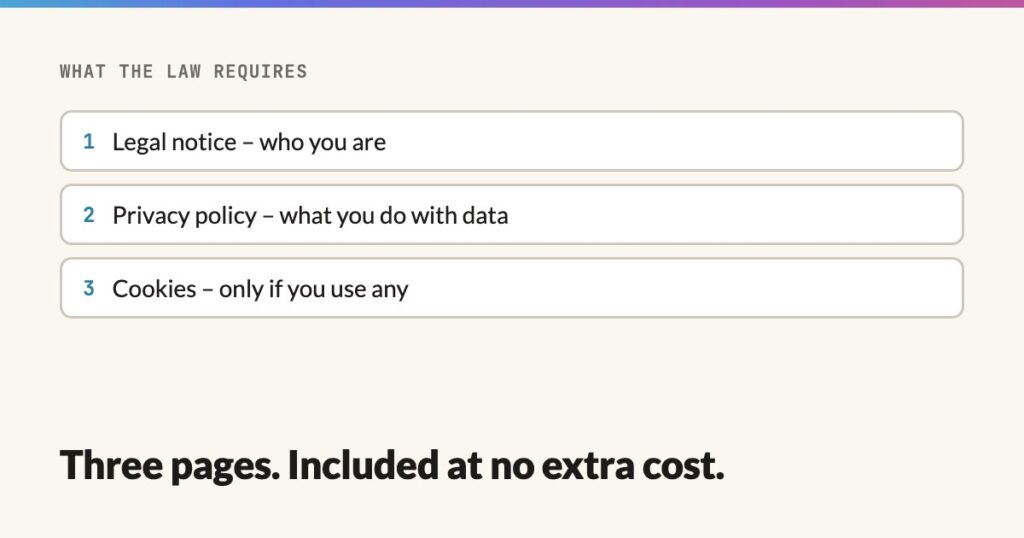
If a website offers products or services, Swiss law requires it to say who runs it and what it does with visitors’ data.
This isn’t a formality for lawyers. It’s what protects you on the day someone disputes something – and, in the meantime, it reassures people who are unsure about getting in touch.
Three pages are enough.
The legal notice
This page says who you are, where you are and how to reach you. It gives your name or company name, your address, your email address, and your business identification number if you have one.
Visitors should be able to see who they’re dealing with without having to look for it.
The privacy policy
What data you collect, why you collect it, and how long you keep it.
You may think you don’t collect any. But even a simple contact form gathers a name, an email address and sometimes a phone number. That’s enough to bring you under data protection law.
This page must also explain how people can ask to see their data, or have it deleted.
Cookies: you don’t always need a banner
A simple brochure website often sets no cookies at all. In that case, there’s nothing to add.
If you use visitor statistics or an embedded map, Swiss law requires you to tell your visitors. Say which cookies you use, what for, and how to refuse them. A section in your privacy policy is enough. Switzerland doesn’t require you to ask for consent first.
A consent banner becomes necessary if you’re also targeting customers in the European Union, where the rules are stricter. Putting one up “just in case” clutters the first thing people see on your site, and it trains your visitors to click without reading.
Why I include them
These three pages come with every package at no extra cost, written in line with Swiss law.
I don’t do it out of generosity. A website delivered without them is an incomplete website, and I’d rather not deliver one.
A word of honest caution: I’m not a lawyer. These pages cover the typical situation of a small business. If your work involves sensitive data – health, finances, children’s data – have them checked by someone who does this for a living.